At a farmers market, “organic,” “spray-free” and “certified” are not interchangeable claims: “organic” is a regulated production and labeling term, “spray-free” is generally an informal claim whose meaning can vary, and “certified” means a named organization or program has verified a particular standard. The distinction matters because the U.S. Department of Agriculture (USDA) reported more than 20,000 certified organic operations in the United States in 2021, while shoppers may encounter produce claims that are not backed by the same inspection system. Knowing who verified a claim—and exactly what was verified—helps customers compare products without assuming that one label guarantees pesticide-free food or superior nutrition.
Organic labeling defines a regulated market-stand claim
The USDA defines organic production as a system managed in accordance with the Organic Foods Production Act and National Organic Program (NOP) regulations. In practical terms, an organic claim concerns how a product was grown, handled and documented—not simply whether a grower says they avoid certain sprays. USDA-accredited certifying agents inspect covered operations and review records for compliance.
The rules apply to production practices and permitted inputs, including soil management, pest control, and the use of synthetic substances. Organic does not mean that no pesticides were used: organic producers may use certain approved substances, while prohibited substances are restricted. Nor does the label establish that food is more nutritious or that it contains no trace residues.
USDA Organic is a specific certification
“USDA Organic” refers to products certified under the NOP, subject to limited regulatory exemptions. For crops, the standards include requirements concerning land and soil management, prohibited substances, and records. The USDA’s organic system also includes inspection and certification by USDA-accredited agents, rather than relying solely on a grower’s verbal assurance.
The label categories depend on the product. Under USDA labeling rules, a multi-ingredient processed product generally may be labeled “organic” when at least 95% of its ingredients, excluding salt and water, are certified organic; “made with organic” products must contain at least 70% organic ingredients and cannot use the USDA Organic seal. These processed-food thresholds are not a shortcut for interpreting a basket of fresh produce, but they show why shoppers should read the exact wording on signs and packaging.
Certification brings inspection, records and accountability
Certification is a verification process, not merely a statement of intent. A certified operation must follow the applicable organic system plan, maintain records and undergo inspections. The USDA’s 2021 count of more than 20,000 U.S. certified organic operations illustrates the scale of the system; it does not mean every small farm at a market is required to be certified. Federal rules provide exemptions for some small operations, including qualifying producers with no more than $5,000 in annual organic sales, but exempt producers still must follow applicable production and handling standards if they make organic claims.
Spray-free describes a grower’s claim, not a uniform legal label
“Spray-free” commonly means that a grower says they did not spray crops with pesticides, but the phrase has no single, generally applicable federal certification standard comparable to USDA Organic. Its meaning can differ: one farm may mean no synthetic pesticides, another may mean no pesticide sprays of any kind, and another may be referring only to a particular crop or growing season. The sign alone does not settle which meaning applies.
The word “spray” can also obscure how a substance was applied. A farm might use a permitted or low-risk product in a form other than spraying, or use a substance it considers compatible with its practices. Conversely, a grower might avoid all pesticide applications but not follow the broader soil, seed, recordkeeping and handling requirements involved in organic certification. Ask for the farm’s definition rather than treating “spray-free” as a synonym for organic or pesticide-free.
Ask what the grower means by spray-free
Useful questions make the claim specific: Does it mean no synthetic pesticides, no pesticides at all, or no sprays during a certain period? Does it apply to every crop at the stand? Does the farm use other pest-control methods or products applied without spraying? A clear answer is more informative than the phrase alone, especially where neighboring farms or market signs use the same words differently.
Pesticide use and pesticide residues are different questions
A claim about farm practices does not by itself tell a shopper whether a product has measurable residues, and a residue result does not necessarily reveal the full growing method. The U.S. Environmental Protection Agency (EPA) sets legal tolerances for pesticide residues on food, while the USDA’s Pesticide Data Program tests food samples and reports residue findings. These systems address different questions from organic certification: compliance with residue limits is not the same as verification of organic production practices.
For context, the USDA’s 2022 Pesticide Data Program summary reported that more than 99% of tested samples had residues below EPA-established tolerances. That finding should not be read as proof that every sample was residue-free or that production methods were identical; it describes tested samples and the applicable tolerance framework. Washing produce under running water is a practical food-safety step, but it does not change how a crop was grown or validate a market claim.
Certified means verified against a named standard
“Certified” is incomplete unless the shopper knows who certified the product and what standard was used. USDA Organic certification is one identifiable system, but other organizations may certify particular environmental, social, food-safety or production attributes. A private certification can be meaningful, yet it does not automatically equal USDA organic status. Look for the certifier’s name, the standard, the product or farm covered, and whether the certification is current.
Third-party certification and self-declared claims
Third-party certification generally involves an independent organization evaluating a business against a defined standard. A self-declared claim, by contrast, is made by the seller without necessarily undergoing independent review. Neither phrase “certified” nor a logo alone tells the whole story: shoppers can ask what was inspected, how often verification occurs, and whether certification covers the farm, a specific crop, or a handling facility.
Small-farm exemptions do not make every claim equivalent
Some small producers may qualify for an exemption from USDA organic certification based on annual organic sales, but an exemption is not the same as certification. An exempt operation must still comply with relevant organic production and handling rules when making an organic claim, and it cannot use the USDA Organic seal or represent its products as certified organic. At a stand, ask whether the farm is certified, exempt, or using a different description such as “grown using organic practices.” The wording identifies different levels of formal verification.
How to compare claims at a market stand
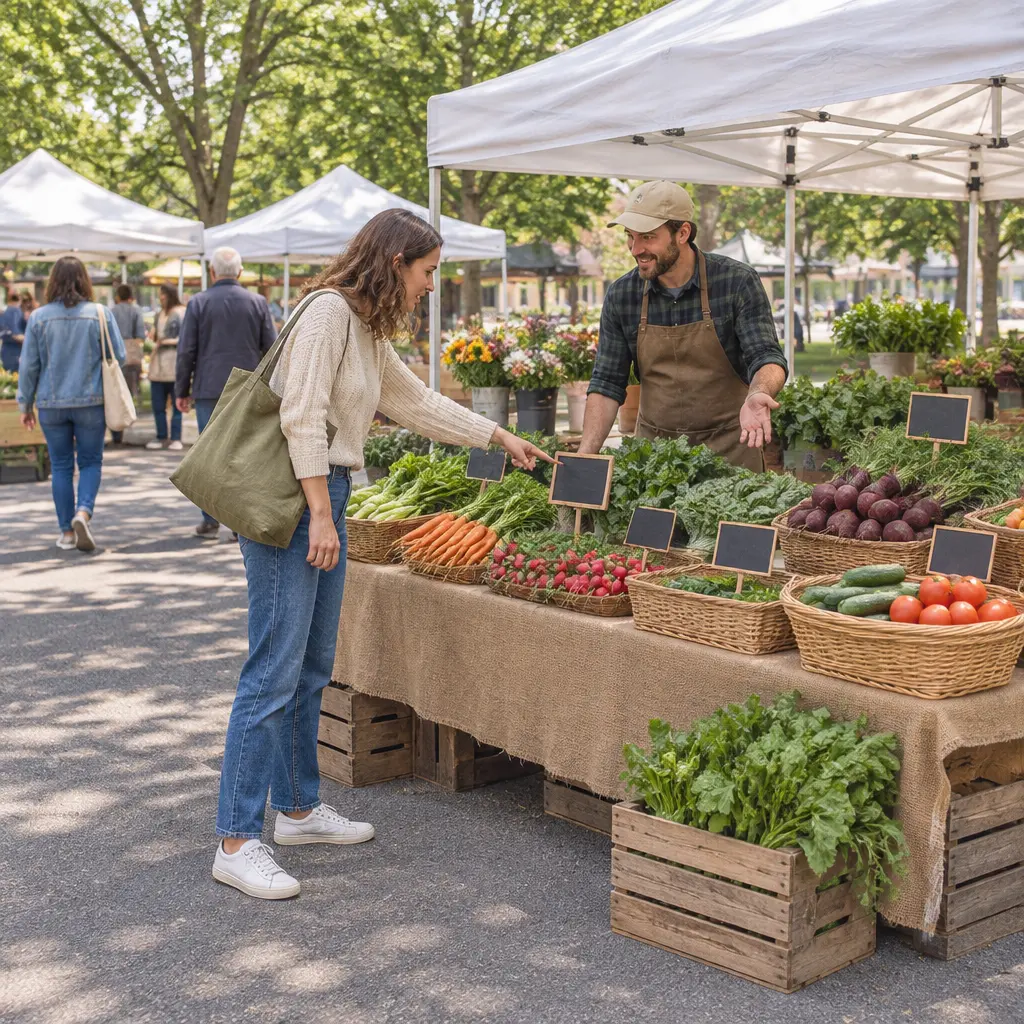
A short conversation can turn a broad label into useful information. The following questions help distinguish regulated certification from a grower’s description without assuming that one production approach suits every shopper.
- “Are you certified organic, exempt from certification, or using another production practice?”
- “If you say spray-free, what exactly does that mean for this crop and this season?”
- “Which organization certified you, and what does its certification cover?”
- “What pest-management methods or products do you use?”
- “Can I see the certification information or learn where to verify it?”
For example, a grower might explain that the farm is USDA-certified organic and provide the certifier’s name; another might say the farm is not certified but does not use synthetic pesticides; a third might define spray-free as no pesticide spraying on a particular crop. These are distinct claims. Recording the exact answer is more useful than translating all three into a single “chemical-free” category.
Conclusion: verify the claim behind the label
Organic is a regulated production and labeling system; spray-free is an informal phrase whose meaning should be clarified; and certified is meaningful only when a named verifier and standard are identified. USDA inspection and certification provide a formal framework for organic claims, while EPA residue tolerances and USDA testing answer different questions about pesticide residues. At your next market visit, read the sign, ask the grower what the wording means, and check the certifier or standard when one is named. That approach supports informed choices and rewards clear, accountable communication.
Sources: U.S. Department of Agriculture, Agricultural Marketing Service, “Organic Standards,” https://www.ams.usda.gov/grades-standards/organic-standards; U.S. Department of Agriculture, Agricultural Marketing Service, “Labeling Organic Products,” https://www.ams.usda.gov/grades-standards/organic-labeling; Electronic Code of Federal Regulations, 7 CFR Part 205—National Organic Program, https://www.ecfr.gov/current/title-7/subtitle-B/chapter-I/subchapter-M/part-205; U.S. Department of Agriculture, National Agricultural Statistics Service, “2021 Organic Survey,” https://www.nass.usda.gov/Publications/AgCensus/2022/Online_Resources/Organics/; U.S. Environmental Protection Agency, “Pesticide Tolerances,” https://www.epa.gov/pesticide-tolerances; U.S. Department of Agriculture, Agricultural Marketing Service, “Pesticide Data Program: Annual Summary, Calendar Year 2022,” https://www.ams.usda.gov/datasets/pdp/pdpdata.