
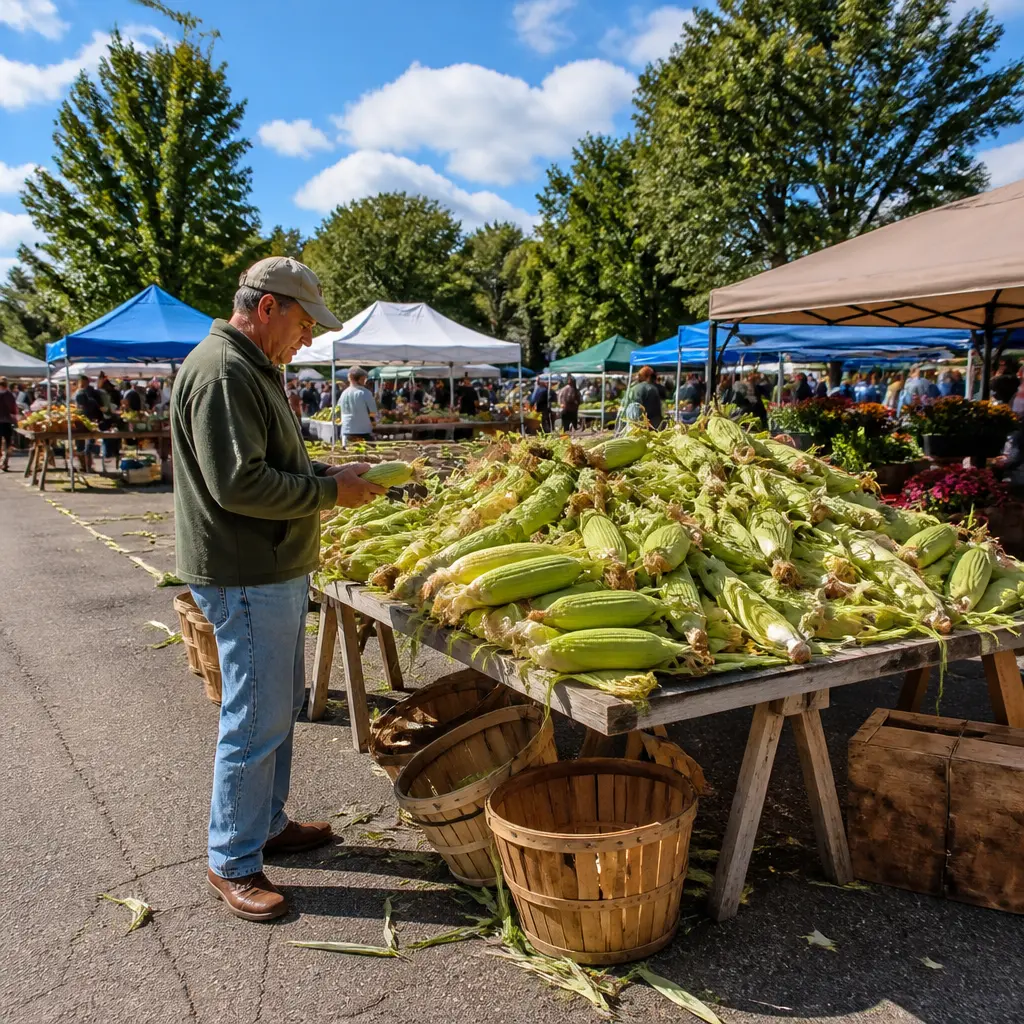
Fresh sweet corn picked this morning is best identified through a combination of cool temperature, bright green husks, moist silk, firm kernels, a freshly cut stem, and trustworthy harvest information—not by appearance alone. Sweet corn is the immature ear of maize harvested while its kernels still contain high levels of sugar and water. Because sugars begin converting to starch after harvest, the University of Minnesota Extension and other land-grant university programs advise buying corn as soon as possible after picking and keeping it cold. The checks below explain how to evaluate harvest freshness, distinguish genuine same-day corn from older produce, and handle it safely.
Freshness Indicates Corn Picked This Morning
“Corn picked this morning” is a harvest-time claim: the ear was removed from the plant earlier on the same calendar day, rather than merely delivered to a store that day. The claim is narrower than “fresh,” because an ear can remain appealing after several days under refrigeration, while a recently picked ear can lose quality quickly if left warm. The United States Department of Agriculture describes quality in sweet corn through characteristics such as tenderness, flavor, kernel development, and freedom from defects; no single visual feature proves the exact picking time.
The main hyponyms of this freshness claim are same-day field harvest, locally harvested corn, recently cooled corn, refrigerated corn, and older but saleable corn. These categories overlap, but they are not interchangeable. A local farm may harvest in the morning and sell in the afternoon, whereas supermarket corn may have traveled hundreds or thousands of miles before display. The strongest evidence therefore combines physical inspection with a direct answer from the grower or seller.
Look for a cool, hydrated ear
Temperature is one of the most useful clues because harvested sweet corn loses quality faster when it stays warm. Michigan State University Extension explains that rapid cooling helps preserve sweetness and quality, while refrigeration slows the conversion of sugars into starch. An ear that feels cool, heavy for its size, and slightly moist is more consistent with recent harvest and proper handling than an ear that feels warm, light, or dehydrated.
Temperature alone does not prove same-day picking. A retailer can refrigerate older corn, and a farm can leave newly picked corn in the sun. Treat coolness as supporting evidence, then inspect the husk, silk, stem, and kernels.
Inspect the husk and silk
A fresh husk is usually green, snug against the ear, and flexible rather than brittle. The silk may be golden, pale green, or light brown depending on the variety and maturity, but it should feel moist and appear relatively glossy. Dry, blackened, slimy, or extensively matted silk suggests age, damage, or poor storage. Brown silk by itself is not a reliable rejection test because silk naturally darkens as the ear matures.
Avoid peeling every ear at a market stand. Pulling back the husk exposes kernels to drying and handling damage. Instead, examine the outer leaves and the tip. A husk that is badly yellowed, loose, split, or papery is a warning sign. Small insect holes, mold, or sour odors are stronger reasons to reject the ear.
Check the cut stem for recent harvest evidence
The stem end is often more informative than the tip. A newly cut stem commonly looks pale, moist, and firm, with a clean cut surface. As the ear ages, the stem can darken, wrinkle, shrink, or develop a dry, woody appearance. A green husk paired with a very dry stem may indicate that the ear was harvested earlier and kept cold.
Stem appearance still cannot establish an exact date. Handling, variety, cutting method, and storage humidity all affect browning. Use it as a relative freshness indicator rather than a timestamp.
Kernel Quality Supports the Corn-Picked-This-Morning Claim
Kernel condition provides a second layer of validation. Sweet-corn kernels should generally look plump, smooth, and well filled for the variety. When gently pressed with a fingernail after husking, a mature sweet-corn kernel should release a milky liquid. Watery liquid can indicate immature kernels, while a thick or scant liquid and shriveled surfaces can indicate overmaturity or moisture loss.
Use plumpness, color, and rows together
Freshness is not the same as color. Yellow, white, and bicolor cultivars naturally differ in pigment, so a bright yellow ear is not automatically newer than a pale or white ear. Look for even kernel development, minimal gaps, and a surface free of dull, collapsed, or dented kernels. The tip may contain smaller kernels because pollination is less complete there; a slightly less-filled tip is not necessarily a sign of old corn.
A useful visual comparison is to line up several ears from the same seller. The freshest group will usually have more consistent moisture, tighter husks, and less stem shrinkage. This comparison is more reliable than judging one ear against an idealized picture.
Do not confuse sweetness with picking time
Variety and maturity affect sweetness as much as elapsed time. Supersweet and sugar-enhanced cultivars can retain sweetness longer than standard sugary cultivars, while an overmature ear may be less tender even if it was picked recently. The University of Illinois Extension notes that the traditional advice to eat corn immediately after harvest reflects real sugar loss, but modern cultivars and cold storage can change how quickly quality declines.
Taste testing can support a seller’s claim, but it is not a safe substitute for hygiene. Cut or sampled corn should be protected from contamination, and consumers should wash hands and utensils before preparation.
Seller Information Validates Corn Picked This Morning
The most direct validation is a specific harvest answer. Ask, “What time was this corn picked?” rather than “Is it fresh?” A credible grower or vendor should be able to explain whether the corn was harvested that morning, the previous evening, or earlier in the week, and whether it was cooled or held at ambient temperature.
Ask about harvest, cooling, and transport
Three questions produce useful evidence: when was it picked, how was it cooled, and how long has it been on display? A farm stand with field-to-market sales may provide a more precise answer than a general grocery label. However, “local” describes origin, not necessarily harvest date, and “farm fresh” is often a marketing phrase rather than a standardized certification.
- Strong evidence: a posted harvest date, a grower’s specific time estimate, cool storage, and intact, hydrated ears.
- Moderate evidence: green husks, moist silk, a pale stem, and a cool display without a documented harvest time.
- Weak evidence: an “organic,” “local,” or “farm fresh” label without harvest or handling details.
Recognize supermarket and farmers-market differences
Farmers markets often shorten the time between harvest and sale, but practices vary by vendor. Supermarket corn may be harvested at a regional or distant farm, packed, transported, cooled, and displayed before purchase. That supply chain can still produce good-quality corn, but it makes a same-morning claim less likely unless the store provides traceable receiving information.
A practical case comparison is two ears with equally green husks: one has a moist stem and comes from a vendor who harvested at dawn; the other has a dry stem and no harvest information. The first ear has stronger evidence of same-day picking, even though neither appearance alone is conclusive.
Storage Preserves the Freshness of Corn Picked This Morning
Buyers can preserve quality by refrigerating sweet corn promptly, leaving the husk on until cooking when practical, and using the ears soon after purchase. The USDA recommends refrigerating perishable produce and following basic clean, separate, cook, and chill practices. Refrigeration slows quality loss; it does not restore sweetness that has already been lost.
Use a short freshness checklist
- Feel for a cool, heavy ear rather than a warm or dehydrated one.
- Choose a green, flexible husk with no mold, slime, or extensive drying.
- Inspect moist silk and a pale, firm, recently cut stem.
- Look for plump, evenly developed kernels when the ear is already husked.
- Ask the seller for the actual harvest date and cooling history.
- Refrigerate the corn promptly and cook it soon for the best flavor and texture.
Read the signs as a combined scorecard
No consumer test can certify that an ear was picked that morning. The most defensible conclusion comes from converging evidence: seller documentation or a specific harvest answer, rapid cooling, a hydrated husk and stem, moist silk, and firm kernels. One weak sign should not outweigh several strong ones, and one attractive husk should not outweigh a dry stem, warm storage, or an evasive harvest history.
In a simple text-based quality chart, “strong same-day evidence” means documented morning harvest plus cool storage; “probable recent harvest” means several fresh physical signs without documentation; and “uncertain or older” means dry stem, brittle husk, shriveled kernels, warm display, or no credible seller information. This approach is more accurate than relying on a single color or slogan.
Conclusion: Confirm Corn Picked This Morning Through Multiple Clues
Corn freshness is best judged through the linked attributes of temperature, hydration, husk condition, silk moisture, stem appearance, kernel development, and harvest traceability. A cool ear with a green, flexible husk, moist silk, pale cut stem, plump kernels, and a specific same-day harvest answer is the strongest candidate. Because variety and storage can imitate some of these signs, shoppers should combine physical inspection with direct questions rather than treating any one feature as proof.
The broader lesson is that postharvest handling matters nearly as much as harvest timing. Choose vendors who can explain when and how produce was picked, keep corn cold after buying it, and use it promptly. For further guidance, consult university extension produce-handling resources and USDA food-safety recommendations.
Sources: United States Department of Agriculture, Agricultural Marketing Service, United States Standards for Grades of Sweet Corn, https://www.ams.usda.gov/sites/default/files/media/SweetCornStandard.pdf; United States Department of Agriculture, Food Safety and Inspection Service, Keep Food Safe! Food Safety Basics, https://www.fsis.usda.gov/food-safety/safe-food-handling-and-preparation/food-safety-basics; University of Minnesota Extension, Selecting and Serving Produce Safely: Sweet Corn, https://extension.umn.edu/preserving-and-preparing/sweet-corn; Michigan State University Extension, Sweet Corn: Harvesting and Handling, https://www.canr.msu.edu/news/sweet_corn_harvesting_and_handling; University of Illinois Extension, Sweet Corn, https://extension.illinois.edu/gardening/sweet-corn